Press Release: Council Celebrates Success of Forest Conservation Program

Press Release: Council Celebrates Success of Forest Conservation Program

Forest Conservation Benefits Communities, Industry in the New York City Watershed

March 8, 2019- Walton, NY- In 2018, the Watershed Agricultural Council (WAC) launched its Forest Conservation Easement Program. “The goal of the Forest Conservation Easement Program is twofold,” stated Easement Program Director Ryan Naatz. “We aim to preserve large tracts of private forestland for both the water quality protection they provide and for the benefit of local industries that they serve. Our easements promote a working landscape, with timber harvesting as well as bluestone mining allowed in accordance to management plans that protect water quality.”  

This program is already proving to be quite successful, as WAC recently closed on its largest project to date, over 1,000 acres of forestland. Ann Rasmussen and her family have owned and managed their lands in Walton, NY for timber production since the 1960’s. “This was a partnership that just made sense,” Rasmussen declared. “The goals of WAC and the Forest Conservation Easement Program closely align with our family’s goals. The easement allows us to continue to use the land for timber production, recreation and hunting as it has been for generations. Our partnership with WAC has helped us create a sustainable plan for the next generation to continue to work and enjoy the property as we have been fortunate to.”
 
Read the full Press Release here.

CDL TRAINING FOR AGRICULTURAL INDUSTRY

CDL TRAINING FOR AGRICULTURAL INDUSTRY
Farm Owners and Employees Eligible for CDL Training

Walton, NY– The Watershed Agricultural Council (WAC) and Cornell Cooperative Extension of Delaware County will be offering a Commercial Driver’s License (CDL) training program for farm owners, producers and their employees in cooperation with Delaware, Chenango, Madison, Otsego (DCMO) BOCES. This CDL Prep Class is a two-day classroom and lab training (eight hours) designed to assist attendees in preparation for NYS testing. The training will be held on Tuesday, February, 19 and Thursday, February 21, 2019 from 10:45 – 3:00 each day in the Conservation Lab at the DCMO BOCES Robert W Harold Campus, 270 BOCES Drive, Sidney Center, NY 13839-3105 (Town of Masonville, Rt. 206).

Agricultural vehicle licensing laws have changed for agricultural operators. In some situations, agricultural vehicles are subject to New York State

Department of Motor Vehicles CDL requirements. This course will introduce you to the materials and key test requirements to obtain your desired CDL.

The registration fee for this program is $20 per person. Lunch will be provided for each session. Attendees may arrange actual drive time directly with the CDL prep class instructor and DCMO BOCES. Fees for this service and any other cost associated to the CDL permit, road test and DOT Physical (as applicable) will be the responsibility of each participant.
 
For more information, or to register for this CDL prep class, please contact Kim Holden at the Watershed Agricultural Program Office, (607) 865-7090 or  email kmh19@cornell.edu. Registrations will be on a first-come first-served basis and preference will be given to WAP participants until the registration deadline of Tuesday, February 12, 2019. Please make checks payable to “Cornell Cooperative Extension” and indicate “CDL Prep Class” on the check. Once your registration is received, additional details will be provided.
 
This program is being funded by the Watershed Agricultural Council and the New York City Department of Environmental Protection. The Watershed Agricultural Council is an equal opportunity provider and employer. Cornell Cooperative Extension in Delaware County provides equal program and employment opportunities.

Agriculture: A Science-Based Approach to Watershed Management

The Watershed Agricultural Council has worked since the first pilot farms participated in 1991, to be a leader in an agricultural science-based approach to watershed management. The program started with a “bricks and mortar” approach to BMPs on farms and has grown to an intensive management based Best Management Practices (BMPs) including Nutrient Management, Agronomic BMPs and Precision Feed Management Programs. Realizing a multi-faceted approach to management was key to soil health and farm waste management.

In 2018, increased participation in the Nutrient Management Credit Program helped 132 farms earn monetary credit for following their prescribed plans for handling manure. 15 farms used this credit for liming fields, which will yield a higher return in crops in the following season. In all, 2,030 tons of lime were spread on 462 acres. 48 farms are currently enrolled in Precision Feed Management, helping manage the nutrients and forages the cows are eating to increase production while reducing phosphorus output.

This year, cover crops were a key focus in Whole Farm Plans, with revisions done to add cover crop BMPs to 39 farms. Establishing a growing cover on fields year round protects water quality by reducing soil erosion, retaining nutrients and improving soil health. In an effort to get more acres of cover crops planted in a short time, a pilot project was done utilizing a helicopter to seed rye into standing corn fields. In two days, 78,000 lbs. of rye seed were broadcasted over 713 acres on 11 farms. As a turnkey operation, JBI Helicopter Services provided the seed, equipment (including a helicopter, two tractors and three trucks with trailers) as well as the personnel needed to complete the project. The seed was applied into standing corn at a rate of 110 lbs./acre using a hopper that hung below the helicopter and was controlled by GPS navigation. The rye seed germinated quickly with the abundant moisture this fall, and as the corn was harvested, ideally within 2-3 weeks, the growing cover crop was already established and growing. The success of this pilot project is being monitored through the fall and into the spring to evaluate how well it works and if it can be utilized on more watershed farms next year.

The Ag Program is continually adapting and looking for more effective ways to serve our farm participants and our watershed. We look forward to the next 25 years of agriculture in the region, and are prepared to serve our farming community as we continue to avoid filtration by utilizing this voluntary system of programs developed over the years by the dedication of board and staff alike.

Read more of the 2018 Annual Report here.

[ngg src=”galleries” ids=”35″ display=”basic_thumbnail”]

Economic Viability: Enhancing the Profitability of Working Landscapes

One of the benefits of the Economic Viability Program is its ability to explore innovative methods for enhancing the profitability of the working landscapes of agriculture and forestry throughout the region. This program has the ability to move quickly to meet the needs of our farmers, adapt to evolving trends in the agricultural community, and act as a source of support for our growing participant base. Because of this, 2018 has seen one of our largest strategic directional shifts to date.

We not only support the Pure Catskills buy local campaign, but for the first time this year, we developed and implemented a competitive micro-grants reimbursement pilot program for any farmer, logger, forester, forest landowner or Pure Catskills member with property inside the New York City Watershed. We also partnered with the Center for Agricultural Development & Entrepreneurship (CADE) to financially support the development of professional business plans for watershed farm or forestry businesses in order to better position these business for improved economic profitability and sustainability.

The purpose of our shift this year is simple. We want to continue to strengthen and foster economic vitality in the Catskills Region by encouraging the implementation of activities that can enhance the economic viability of individual farm and forest businesses. The first round of grants were open from September 1–September 30, 2018. We are pleased to report that we had 14 applications and approved $34,940 for reimbursement activities that include training (continuing education) and marketing (branding, advertising, communications related to the marketing services). This is just the start of what our role is, not only internally at the Watershed Agricultural Council (WAC), but externally in what will be crucial for diversification, expansion, advancement in technology and much more for our participants into the near future.

This year marks 25 years of the WAC. Continued growth and success of the Economic Viability Program will continue to push us, this region and our participants into the next 25 years.

Read more of the 2018 Annual Report here.

[ngg src=”galleries” ids=”34″ display=”basic_thumbnail”]

Forestry Easements: A Critical Role in Conservation

The Agricultural Conservation Easement Program began in 1998, as a tool developed to protect participant farms with Whole Farm Plans from parcelization. Our approach to land acquisition differs greatly to other land trusts in the region, as landowners retain ownership of their property and may continue to use it for agriculture and other activities. To date, 28,800 acres have been conserved through this program, allowing the landscape to remain in farm and forest production, helping the region sustain its economic viability.

Realizing that forest lands cover 78% of the NYC Watershed, and the critical role healthy forests play in the protection of water quality, the pilot program for Forest Conservation Easements (FCE) was launched in 2015. After years of developing the program, the first solicitation was sent out to 119 landowners covering 28,000 acres who currently had a WAC Forest Management plan and were enrolled in NYS 480a Forest Tax Law. The parcels also had to be at least 100 acres in size.

In September of 2018, WAC closed on its first FCE of 210 acres. Another 2,300 acres are currently in contract, with an additional 500 acres in negotiation. In a short time, this program has been a great success in the protection of working forest lands from parcelization and development. Logging, bluestone mining and farming are among the 15 Reserved Rights all WAC Easement landowners retain.

The Conservation Easement Program has evolved over the years to meet the needs of the region’s producers. Working with farm and forest families to keep their land intact and in production is key to the region’s success for the next 25 years and beyond.

Read more of the 2018 Annual Report here.

[ngg src=”galleries” ids=”33″ display=”basic_thumbnail”]

East of Hudson: Adapting to Change

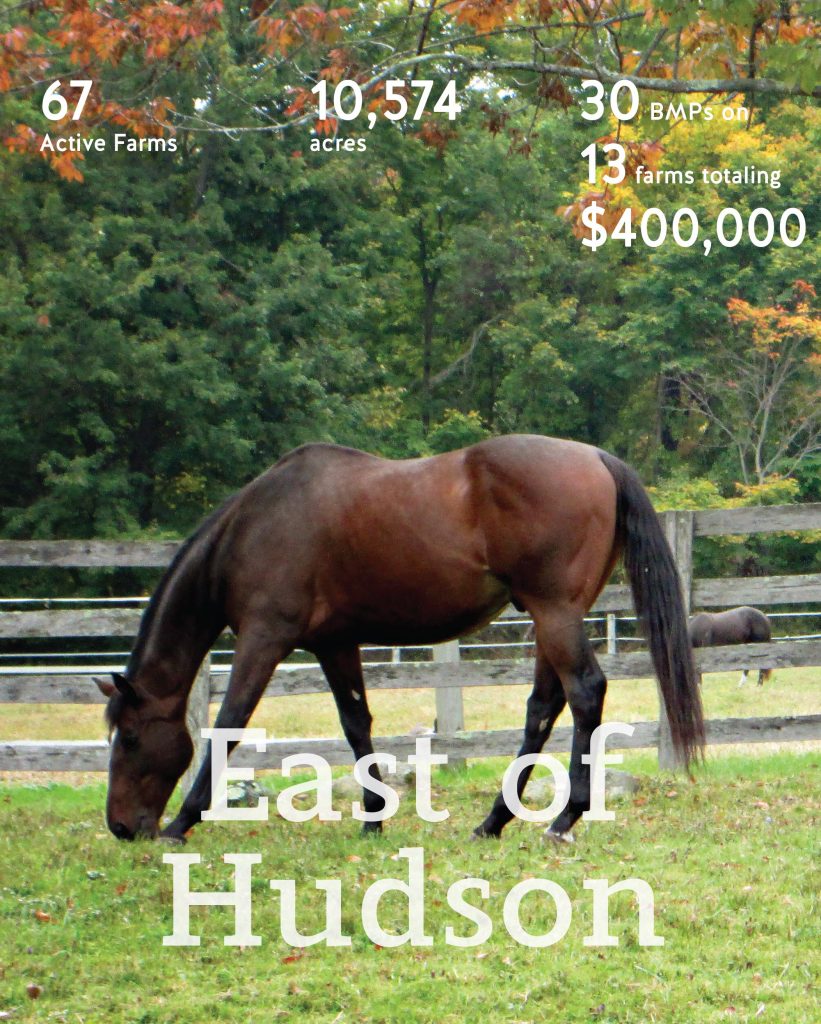
The Croton Watershed is a diverse and dynamic environment. Changes in land use, development pressure and rising land values present significant challenges to East of Hudson farms. The Watershed Agricultural Council works with our farm partners to provide technical assistance, implement best management practices and promote the economic viability of farm operations.

Akindale Farm, located on 800 acres of pristine land in Pawling, NY, joined the Watershed Agricultural Council in 1997 as one of three “pilot farms” for the East of Hudson Program. Akindale’s reputation as one the top thoroughbred breeding operation and training facilities in New York State and the farm’s commitment to environmental conservation helped establish WAC’s presence in the Croton watershed. In 2006, the Akindale Thoroughbred Rescue was established at the farm to provide a home for the horses that are no longer able to race. Today, the focus of farm’s operation has shifted from breeding and training to providing a nationally recognized safe haven for thoroughbreds.

The East of Hudson Program has implemented 26 BMPs at Akindale Farm, including a riparian cover, a manure compost facility, a stream crossing, as well as a nutrient management plan and prescribed grazing plans. The East of Hudson team implemented an innovative solar watering system to provide water to remote fields, enabling the farm to exclude the horses from a water course. This fall, Akindale Farm participated in the Watershed Agricultural Council’s new Economic Viability Micro Grant Program and has been awarded funding to develop the farm’s marketing and outreach efforts.

The East of Hudson Agricultural Program has adapted to challenges within the Croton Watershed to meet the needs of our farm partners, preserve agricultural landscapes and protect drinking water quality, and will continue to do so for years to come.

Read more of the 2018 Annual Report here.

[ngg src=”galleries” ids=”32″ display=”basic_thumbnail”]

Forestry: The Future of Logging in the NYC Watershed

Every year the WAC Forestry Program uses technical assistance and cost-sharing to help Watershed loggers install water quality protection measures called Best Management Practices (BMPs) on timber harvests in the Watershed. Until recently, however, we had no way to gauge our impact with loggers. Unlike farms that generally don’t change location, loggers move vastly throughout the landscape. And unlike some other states, New York has no system of timber harvest notification that requires landowners or loggers to alert the state before they log.  Lacking such a system, we had no way of knowing how much logging was happening in the New York City Watershed, the extent of its threat to water quality, or how effective our programs were at reducing water pollution from logging.

That changed in 2017, when we learned about a computer program called Feature Analyst that can use aerial photographs to find the small gaps in the forest canopy created by logging. We set out to use Feature Analyst to get an idea of how much logging occurred in the Watershed over the previous years.

This project revealed, for the first time ever, the scope of logging in the New York City Watershed. We learned that the Watershed has 183 timber harvests on private lands annually, covering an area of 7,092 acres. This area represents 1.25% of the Watershed’s private forest cover, a level of harvesting that should allow for a sustained yield of timber over time. Our logging BMP cost-share program works on 45 of these harvests annually, or 25%. However, the program works primarily on larger harvests, so 40% of the harvested acres occurred on logging jobs where we funded BMPs.

We also learned that the cutting of trees specifically is not a water quality threat to New York’s water supply. Nearly all acres logged were light harvests (93%), meaning loggers removed less than 50% of the canopy. Almost no logging (5% of harvested acres) occurred within 100 feet of a stream, and 96% of that logging was light. This is good news for water quality, because previous research in the Watershed has found that when canopy removal is less than 50%, increases in common water pollutants like nitrates are minimal and short term. Only when intensity increases beyond 50% do those increases become significant and long lasting. That said, the systems of roads and trails loggers use to remove timber from the woods can still cause water quality problems even on light harvests, so we plan to expand our efforts to help loggers install more BMPs on those trails in the future.

Read more of the 2018 Annual Report here.

[ngg src=”galleries” ids=”31″ display=”basic_thumbnail”]